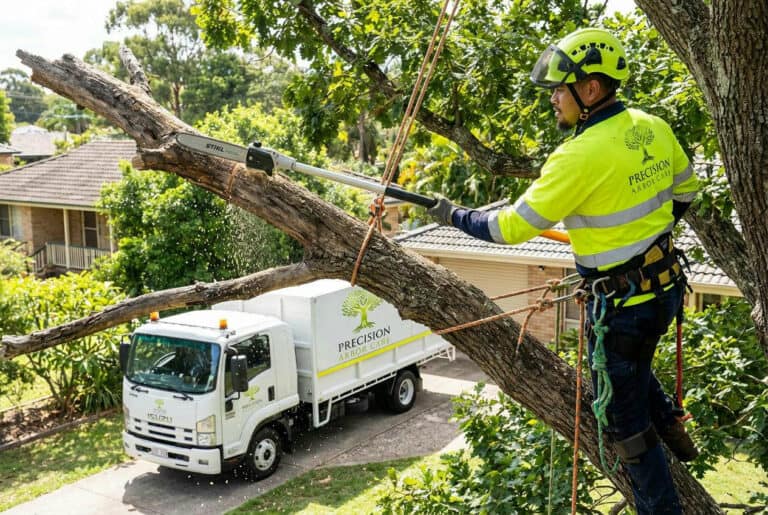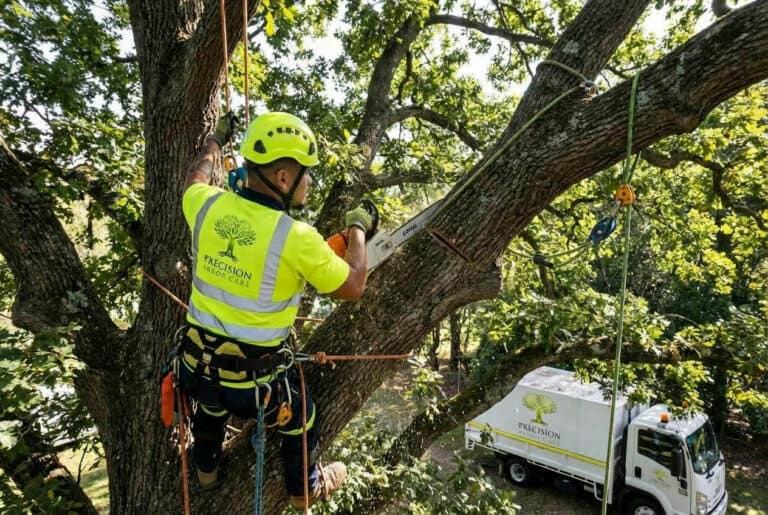
Tree pruning in Melbourne costs between $250 and $2,500 in 2026, depending on tree height, species, the type of pruning needed, and how easy we can access the canopy. A small ornamental tree gets a light shape trim for $250 to $500. A mature Spotted Gum needing a 30% crown reduction with EWP access sits at the top of the range. This guide breaks the price down by job type and tree size so you know what you’re paying for before the quote lands.
Average Tree Pruning Cost in Melbourne
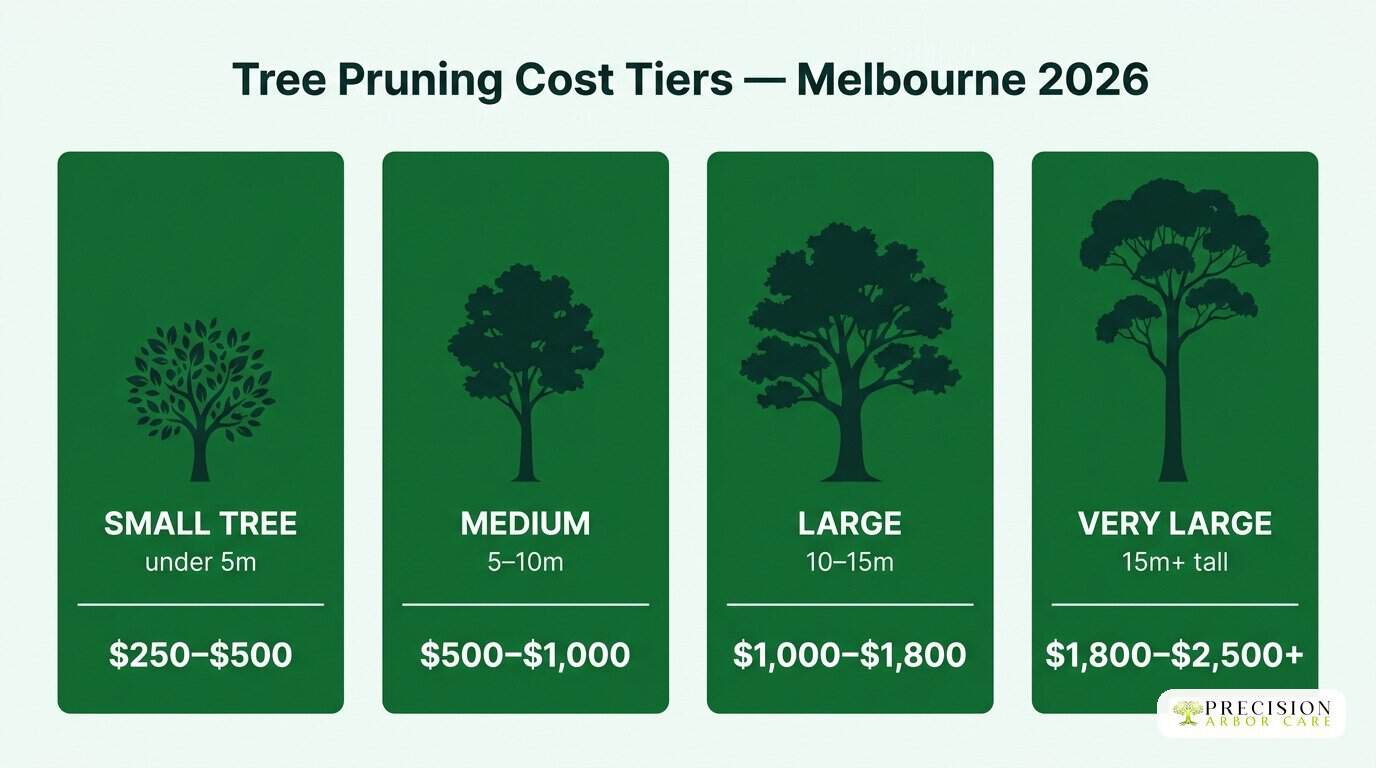
Pricing scales with height — once a tree goes past 5m, the equipment, time, and risk all step up together. Here’s the range you’ll see across Melbourne in 2026:
- Small tree (under 5m) — $250 to $500 (ornamentals, fruit trees, young shade trees)
- Medium tree (5-10m) — $500 to $1,000 (mature shade trees, established eucalypts under 10m)
- Large tree (10-15m) — $1,000 to $1,800 (mature Spotted Gum, mature Plane, mature Liquidambar)
- Very large tree (15m+) — $1,800 to $2,500+ (mature River Red Gum, large Eucalypts, anything needing EWP)
These figures cover the climb (or EWP setup), the pruning cuts, branch lowering, chipping all material, and leaving the site clean. Council permit fees and post-prune crown maintenance are usually quoted separately.
Related reading
- Our Tree Pruning Services page — full overview of how we prune trees across Melbourne.
- When Is the Best Time to Prune Trees in Melbourne?
- Tree Lopping vs Tree Pruning: What’s the Difference?
- 7 Tree Pruning Mistakes That Can Kill Your Tree
The Six Types of Tree Pruning — And What Each Costs
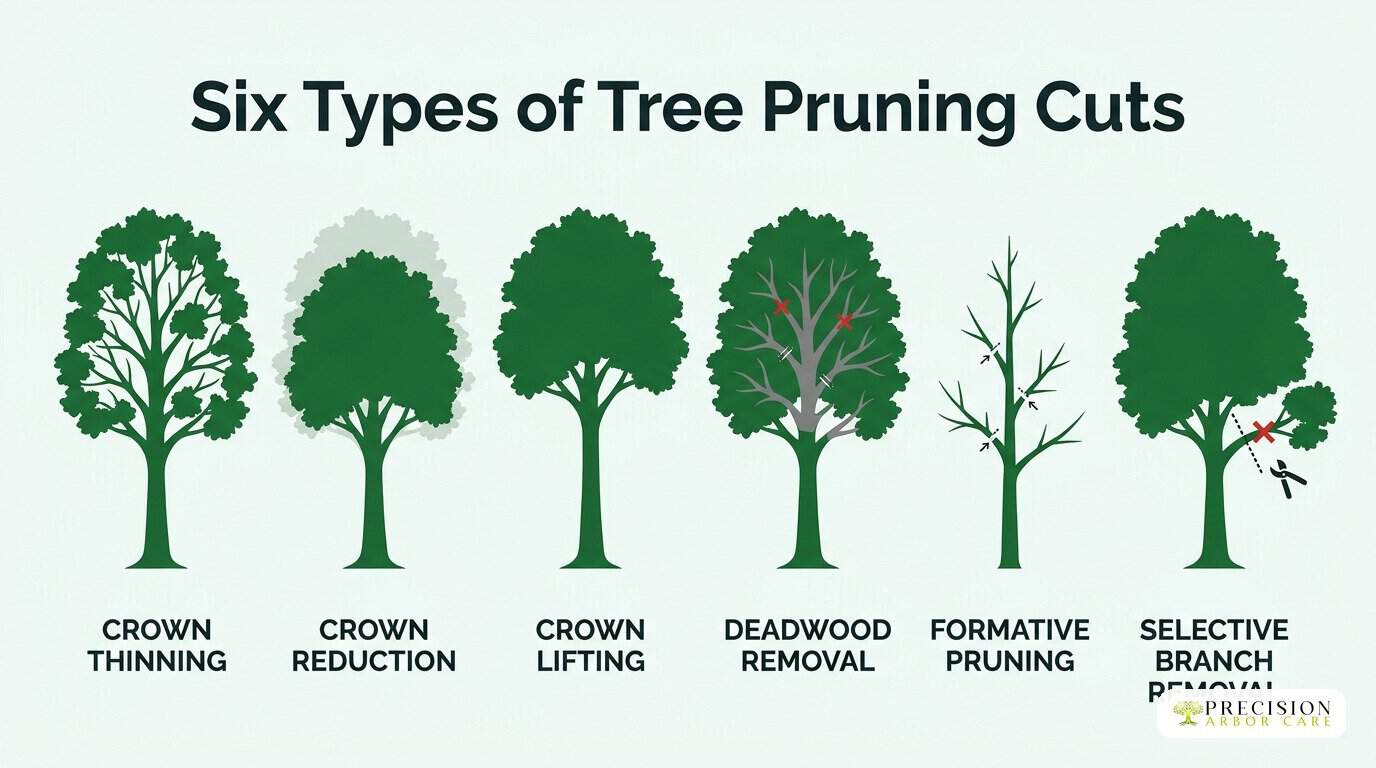
Most quotes describe the work in arborist terms. Knowing what those terms actually mean lets you compare quotes fairly and ask the right questions. All six are defined under Australian Standard AS 4373-2007 [1].
1. Crown thinning — $400 to $1,500
Selective removal of interior branches to let more light and wind move through the canopy. Used on dense-canopy species like Plane Trees and mature Eucalypts to reduce wind sail and improve light penetration. Removes about 10-20% of canopy mass.
2. Crown reduction — $600 to $2,200
Selective shortening of the entire canopy by 20-30% using target pruning cuts back to live laterals. Used when a tree is too tall for its space, blocking light, or showing structural weakness. NOT topping — topping is what Arboriculture Australia explicitly calls out as bad practice [6].
3. Crown lifting — $300 to $1,000
Removal of lower branches to lift the canopy off the ground, driveway, roof or pedestrian path. Common on street-frontage Eucalypts that have dropped low limbs over years.
4. Deadwood removal — $250 to $800
Removal of dead, dying, or diseased branches throughout the canopy. Should be done annually on mature trees as a safety measure. Council of Melbourne’s vegetation rules [2] treat deadwood removal as routine maintenance not requiring a permit on most species.
5. Formative pruning — $200 to $500
Light shaping cuts on young trees in their first 5-7 years to develop a strong central leader and balanced branch structure. Cheap, but the impact on the tree’s life-long shape is bigger than any other pruning type.
6. Selective branch removal — $300 to $1,200
Removal of one or two specific branches — usually because they’re over a roof, threatening powerlines, or rubbing against another branch. Energy Safe Victoria’s powerline clearance rules [3] often drive this work.
Why Crown Reduction Beats Tree Removal Most of the Time
A lot of people ring us asking for a removal when a crown reduction would solve every problem they listed: blocking light, threatening the gutters, looking unsafe.
A 30% reduction on a 12m Plane Tree costs around $1,000-$1,400 and visibly transforms the tree within a week. Removing the same tree costs $2,500-$4,000 (plus $400-$800 to stump grind), takes out a 20-year-old asset, and leaves you with a stump and a hole. Reduction is one-third the cost, keeps the asset, and lets you reassess in 5 years.
The only times we recommend removal over reduction: severe trunk decay, root plate failure, dead tree, or wrong-species-for-the-spot beyond what a single reduction can solve.
Related service
Hedge Trimming in Melbourne
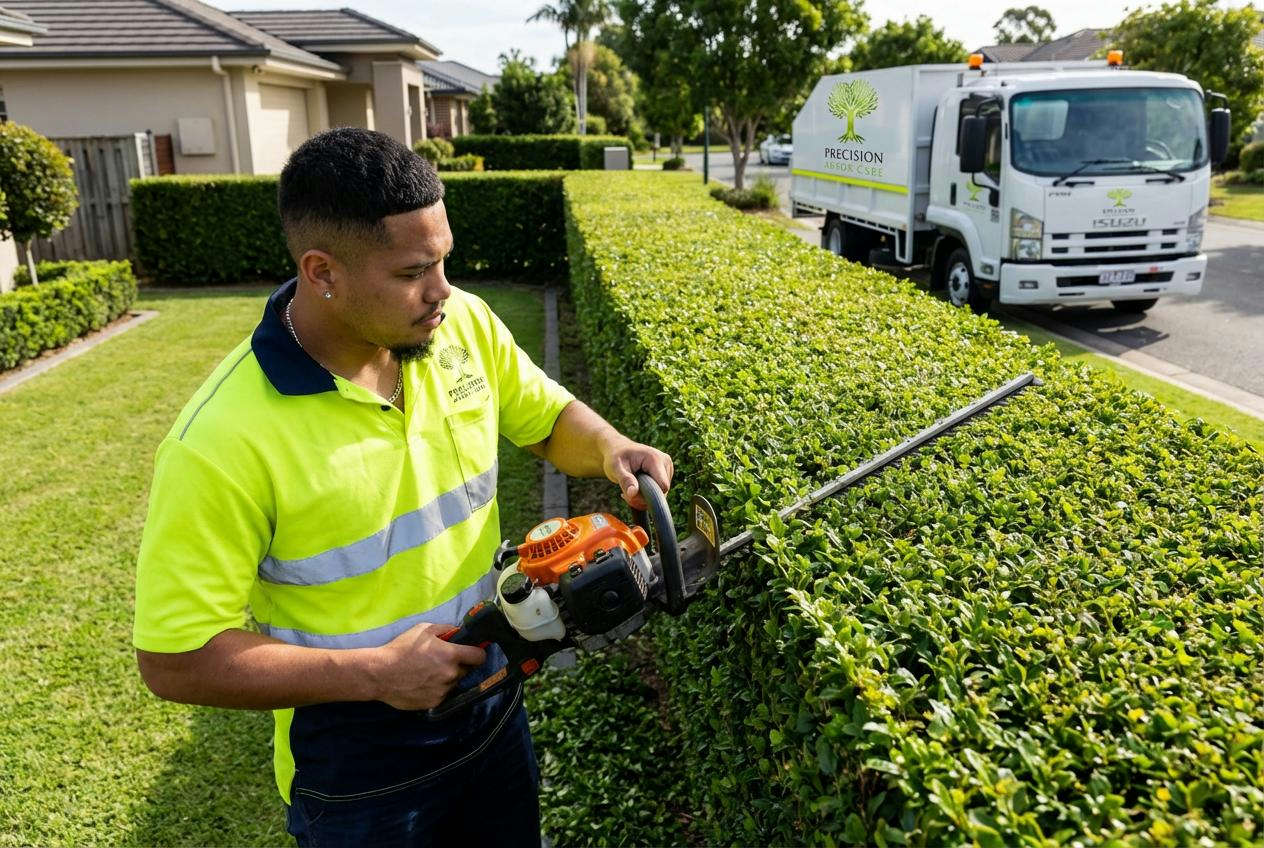
Most trees with adjacent hedges share a quote-day visit cleanly — same crew, same chipper, same disposal. If you’ve got both jobs on the list, ask for the combined price and you’ll usually save the second call-out fee.
What Drives the Price — Honest Factors
Three things explain most of the variation in quotes for the same tree.
1. Access
A tree on a kerb-side nature strip with the trunk 3m from the road is the cheapest possible job — truck pulls up, chipper sits next to it, no lifting waste through gates. The same tree in a tight rear yard with a 1m side gate doubles the price because every piece of waste has to be carried out by hand. WorkSafe Victoria’s working-at-heights regulations [4] also kick in when access slows the climb.
2. Species and wood type
Eucalypts have dense, hard wood that blunts chains faster — pruning a mature River Red Gum takes longer than the same-size Plane Tree. Native Plants Society Australia tracks the relative difficulty of common Melbourne pruning species [5].
3. Council permits
Most Melbourne councils protect trees above a certain trunk diameter or in heritage overlays. If your tree needs a permit, factor in $80-$300 in council application fees and 4-8 weeks of waiting. We handle the permit application as part of the quote.
What’s Included vs What’s Extra
- Climb or EWP setup
- All pruning cuts to AS 4373-2007
- Branch lowering with ropes
- Chipping or removal of all green waste
- Site clean-up — raked, swept
- Council permit application fees
- Powerline clearance (line-clearance arborist)
- EWP/cherry-picker hire for 15m+ trees
- Cabling or bracing
- Lawn or path repair if rope damage
How to Get an Accurate Tree Pruning Quote
For a quote, send us:
- Photos from a few angles — one wide showing the whole tree, one close-up of the trunk
- Rough height estimate (eye-level is ~1.7m, single-storey eaves are ~2.5m, double-storey is ~5-6m)
- Species if you know it — if not, a leaf and bark photo
- What you want changed — lift the canopy, reduce the height, take dead branches out, etc.
- Access notes — gate width, slope, anything sitting under or near the tree
For anything 10m+ tall, we’ll come out and inspect on site. The site visit is free, and the quote we give there is the price we’ll do it for.
Ready when you are
Let’s get your trees pruned right
When you get in touch, here’s what happens: Rob calls you back personally, usually the same day. We talk through the tree — how tall, what species, what you want to change — and book an on-site visit within 24 to 48 hours if it needs one. You get a written quote covering the climb, the cuts, the chipping and the clean-up, with extras like council permits or powerline clearance itemised separately.
No pushy sales, no "we’ll see when we start" pricing, no surprise extras at the end. Just a clear plan, a fair number, and a tree that looks — and stays — healthy.
Servicing Melbourne metropolitan and outer suburbs. Email: [email protected]
Written by
Rob Tufuga
Founder & Lead Arborist, Precision Arbor Care
Rob has been climbing, cutting and shaping trees across Melbourne for more than 15 years. He started Precision Arbor Care to do tree work the way he always wished he could when he worked for bigger crews — one job at a time, no upselling, and an honest number on the quote. He still personally inspects every job over $1,000 and answers the phone himself whenever he’s not up a tree.
Need a tree pruned, a hedge trimmed, or a stump out? Call Rob on 0413 606 544 or request a quote online.
Sources
- Australian Standard AS 4373-2007 — Pruning of amenity trees
- City of Melbourne — Vegetation on private property
- Energy Safe Victoria — Powerline clearance for vegetation
- WorkSafe Victoria — Working at heights
- Australian Native Plants Society — pruning native species
- Arboriculture Australia — Industry standards
Frequently Asked Questions
How much does tree pruning cost in Melbourne?
What’s the difference between pruning and lopping?
How often should trees be pruned?
Do I need a permit to prune a tree in Melbourne?
What’s the best time of year to prune trees in Melbourne?
Is crown reduction better than tree removal?