Planning a new build, subdivision, or bushfire cleanup? Land clearing is usually the first step — and in Melbourne, it comes with rules. Council permits, vegetation overlays, and environmental protections all affect what you can and can’t remove.
This guide explains when land clearing is needed, what’s involved, what it costs, and how to stay on the right side of your local council.
When Do You Need Land Clearing?
Land clearing covers any situation where trees, stumps, scrub, or vegetation need to be removed from a site. The most common reasons in Melbourne include:
- New home builds — builders need a clean, level site before construction starts
- Knockdown rebuilds — removing old landscaping and overgrown trees from an existing block
- Subdivisions — splitting one large block into two or more lots often requires clearing boundaries and access points
- Bushfire preparation — creating defendable space around properties in designated bushfire zones (BAL ratings)
- Commercial development — preparing land for commercial or industrial construction
- Rural property management — clearing overgrown paddocks, fence lines, or fire breaks
If you’re building in Melbourne’s outer suburbs — places like Sunbury, Craigieburn, or the Yarra Ranges — land clearing is almost always part of the process.
Do You Need a Council Permit?
In most cases, yes. Melbourne’s 31 local councils each have their own rules about tree and vegetation removal. Here is what you need to check:
Vegetation Protection Overlays (VPO)
Many Melbourne suburbs have a Vegetation Protection Overlay on their planning scheme. This means certain trees or vegetation types are protected, and you need a planning permit to remove them — even on private land.
You can check overlays on your property through VicPlan (the Victorian Government’s online planning tool) or by calling your local council’s planning department.
Significant Tree Registers
Some councils maintain registers of significant trees. These trees cannot be removed without specific approval, regardless of your development plans. Penalties for removing a registered tree without a permit can exceed $100,000.
Environmental Significance Overlays (ESO)
Properties near waterways, wetlands, or areas with native habitat may have an ESO. Clearing vegetation in these areas triggers additional requirements, including ecological assessments and offset planting.
Bushfire Management Overlays (BMO)
If your property is in a designated bushfire area, you may actually be required to clear vegetation within a certain distance of buildings. The CFA’s defendable space guidelines allow removal of vegetation within 10 metres of a dwelling without a permit in most cases.
What Happens If You Clear Without a Permit?
Councils take unlawful clearing seriously. Fines range from $10,000 to over $500,000 depending on the significance of the vegetation and the extent of the clearing. You may also be required to replant at your own cost.
What’s Involved in Land Clearing?
A typical land clearing job in Melbourne includes several stages:
1. Site Assessment
Before any work begins, the site needs a proper assessment. This identifies:
- Trees that need removal and their size
- Any protected species (both trees and wildlife)
- Underground services (water, gas, electrical, telecoms)
- Access for machinery
- Soil conditions and slope
Precision Arbor Care starts every land clearing job with a site walkthrough to map out the work and flag any issues before equipment arrives.
2. Tree Removal
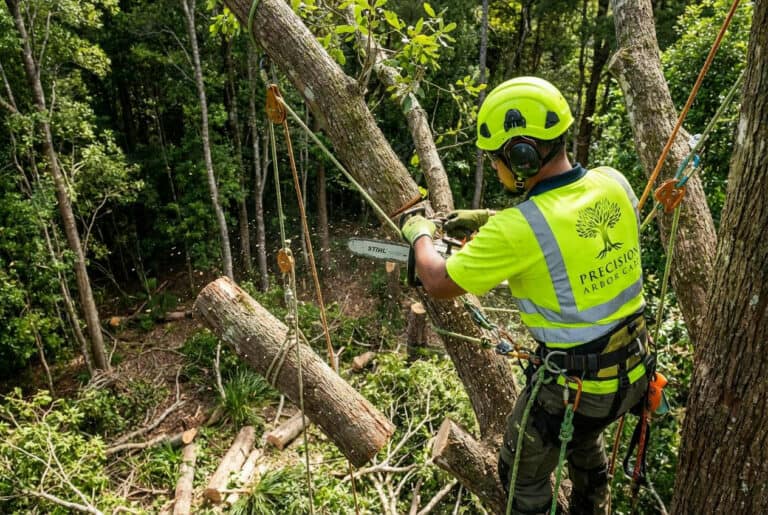
Large trees are removed first. Depending on access and proximity to structures, this may involve:
- Sectional dismantling (climbing and lowering pieces)
- Crane-assisted removal for very large trees
- Straight felling on open blocks
Each tree is cut to ground level, with the timber either chipped on-site or removed.
3. Stump Grinding
After trees are felled, stumps are ground below ground level — typically 200-300mm deep. This allows for construction, landscaping, or turf without obstruction.
4. Scrub and Brush Clearing
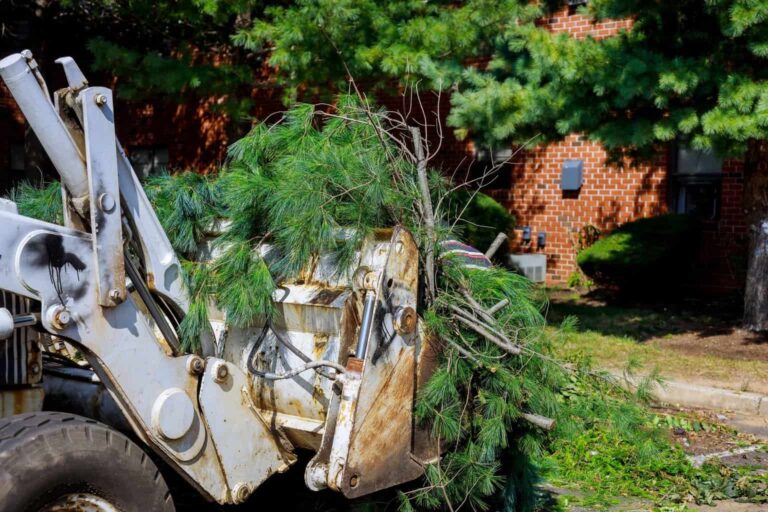
Smaller vegetation — shrubs, scrub, weeds, and undergrowth — is cleared using a combination of machinery and hand tools. On larger blocks, a bobcat or excavator with a mulching head makes quick work of dense scrub.
5. Green Waste Removal
All cleared material is either:
- Chipped on-site and spread as mulch (if the client wants it)
- Loaded and removed to a licensed green waste facility
- Processed for firewood if the timber is suitable
A typical residential block generates 5-15 cubic metres of green waste. Larger rural or semi-rural blocks can produce significantly more.
How Long Does Land Clearing Take?
Timeframes depend on the size of the block and how much vegetation needs to go:
| Block Size | Vegetation Density | Typical Timeframe | |—|—|—| | Standard residential (500-700m2) | Light (a few trees, garden beds) | 1 day | | Standard residential (500-700m2) | Heavy (multiple large trees, dense scrub) | 1-2 days | | Large residential (700-1,500m2) | Moderate to heavy | 2-3 days | | Rural/semi-rural (1,500m2+) | Heavy scrub and trees | 3-5 days |
Weather, access restrictions, and permit conditions can add time. If protected species are found during the work (such as nesting birds), clearing may need to pause until a wildlife assessment is done.
How Much Does Land Clearing Cost in Melbourne?
Cost varies widely based on:
- Number and size of trees: A single medium tree might cost $500-$1,500 to remove. A block with 10+ large trees will cost significantly more
- Stump grinding: Typically $100-$400 per stump, depending on size and access
- Scrub and brush clearing: Usually quoted per hour or per square metre
- Green waste removal: $150-$400 per load depending on volume
- Permit costs: Council planning permits range from $200-$1,500+
For a standard residential block in Melbourne with moderate vegetation, expect to pay between $3,000 and $10,000 for full clearing. Larger blocks or heavily treed properties can run $10,000-$30,000 or more.
The best way to get an accurate figure is to have someone walk the site with you and provide a detailed written quote.
Environmental Considerations
Responsible land clearing isn’t just about following the law — it’s about minimising environmental impact. Key considerations include:
- Native vegetation: Victoria’s native vegetation framework requires offsets when native trees or plants are removed. This can mean planting replacement vegetation or purchasing offset credits
- Wildlife: Possums, birds, and bats often nest in trees scheduled for removal. A pre-clearance fauna survey may be required
- Soil erosion: Removing vegetation from sloped blocks can cause erosion. Silt fencing, mulching, or temporary ground cover may be needed after clearing
- Waterways: Clearing near creeks or drainage lines requires additional permits from Melbourne Water
Get a Quote for Your Land Clearing Project
Whether you’re preparing a block for a new build, clearing for a subdivision, or managing fire risk, the first step is always the same — get a proper site assessment and a clear quote.
Call Rob on 0413 606 544 to arrange a site visit. Precision Arbor Care handles land clearing projects across Greater Melbourne, from single residential blocks to larger semi-rural properties. Rob will walk the site, advise on permits, and give you a detailed quote with no surprises.