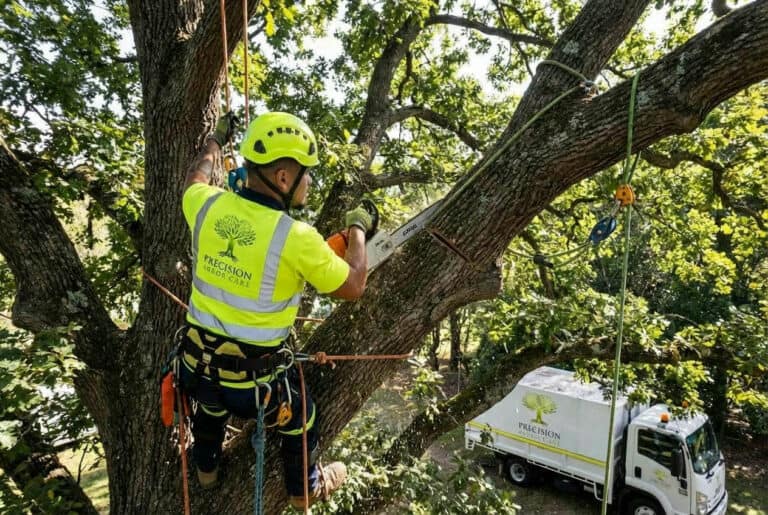
The 1/2/3 rule of pruning is a simple way to take a heavy branch off a tree in three cuts, so the limb cannot tear a strip of bark down the trunk as it falls. It is also known as the three-cut method. Done in the right order, it leaves a small, clean wound in the right place. Done in one cut, it can leave the trunk with an injury the tree never needed.
This guide explains what the 1/2/3 rule of pruning is, what each cut does, where the branch collar sits, and the cases where the rule does not apply. The figures come from the sources listed at the bottom of the page.
Related reading
- Our tree pruning service: how we prune trees across Melbourne.
- Tree pruning mistakes to avoid: seven cuts that can hurt a tree.
- The best time to prune trees: when in the year to make these cuts.
- Tree permits in Melbourne: when a council rule applies.
What Is the 1/2/3 Rule of Pruning?
The 1/2/3 rule of pruning is a short name for three cuts made in a set order. Cut one is a notch on the underside of the branch. Cut two comes from the top, a little further out, and takes the weight off. Cut three removes the short stub that is left, just outside the branch collar[1].
Different guides use different names. The US Forest Service calls it a three-step pruning cut[2], and University of Florida extension staff call it the 3-cut method[3]. All of them describe the same job.
The idea is the same in every guide. A heavy limb cut through in one go can rip away under its own weight before the saw is finished[3]. As it drops, it can pull bark away from the trunk. The notch in cut one is there to stop that[2].

The 1/2/3 Rule of Pruning, Step by Step
Here is how the 1/2/3 rule of pruning works on a limb that is too heavy to hold. Read all three steps before anyone picks up a saw.
The order is the whole point of the 1/2/3 rule of pruning. University of Florida extension staff explain that without the first cut, the weight of the branch will likely rip the bark on the main trunk as it goes[3]. The ISA says the technique of taking the weight off first, then cutting back to the branch collar, reduces the possibility of tearing the bark[1].
By cut three, the weight is gone. The last cut is a small, controlled one, and that is where the care goes. Which brings us to the collar.
Why the 1/2/3 Rule of Pruning Works
Bark ripping is the damage the rule is built to prevent. The US Forest Service lists it among the practices that harm trees, and says improper pruning cuts cause unnecessary injury and bark ripping[2]. The same guide says the three-step method is even more critical on large living branches, because bark ripping is more likely on them[2].
In other words, the 1/2/3 rule of pruning is not fussy. It is how you stop the weight of the limb doing the cutting for you.
“Tree was pruned perfectly”
Russell · ★★★★★ verified Google review
The Branch Collar: Where the 1/2/3 Rule of Pruning Ends
The branch collar is the shoulder or bulge at the base of a branch, built up from overlapping layers of branch and stem tissue[2]. On a healthy limb it shows as a swelling at the base of the limb[4].
Whitehorse City Council explains why it matters. The collar holds the tissue that helps the tree grow over the wound, so it should never be cut. The cut goes just outside it[4]. If you can’t see a collar, the branch bark ridge is the guide. That is the wrinkle in the bark on the trunk[4].
The ISA agrees. A correct cut removes the branch just outside the collar, and it should never be flush to the trunk, because the trunk tissue above and below a flush cut often dies and leaves dead spots[1].
| Cut position | What the sources say |
|---|---|
| Flush with the trunk | Injures the trunk tissue and can lead to decay[2]. AS 4373 lists flush cutting as an unacceptable practice[5]. |
| Just outside the collar | The recommended cut. The collar is left in place to grow over the wound[4]. |
| Too far out, leaving a stub | Slows the wound closing and can give canker fungi a way in[2]. |
Dead limbs follow the same rule. The collar keeps growing while the limb dies[2], so the ISA says to cut just beyond it and not into it[1].
There is no need to paint the wound afterwards. The ISA points to research showing that wound dressings do not reduce decay or speed up wound closure, and most experts recommend not using them[1].
- Make the undercut first, on the underside of the limb
- Make the top cut a little further out than the notch
- Cut the last stub just outside the branch collar
- Use a sharp saw so every cut is clean[2]
- Decide where the limb will land before the first cut
- Cutting a heavy limb through from the top only
- Making the final cut flush with the trunk
- Leaving a long stub
- Painting or sealing the wound[1]
- Standing under the limb, or working from a ladder with a chainsaw
When Not to Use the 1/2/3 Rule of Pruning
The rule has one job: taking a heavy limb off a tree. It is not the right answer to every cut. These are the cases where it does not apply, or where the person holding the saw should not be you.

- Small branches you can hold. The US Forest Service says a branch big enough to need a saw should be supported with one hand while it is cut. It is only when a branch is too large to support that the guide calls for the three-step cut[2]. A small branch you can hold needs a single cut, just outside the collar.
- Branches that do not need to come off. The ISA says no branch should be removed without a reason[1]. The US Forest Service gives a rough guide for branch width: under 5 cm, go ahead; between 5 and 10 cm, think twice; over 10 cm, have a good reason[2]. The 1/2/3 rule of pruning tells you how to cut. It does not tell you whether to cut. The ISA also warns that removing a single large limb can leave a wound that may not be able to close[1].
- Anything near powerlines. The US Forest Service says never to prune trees that are touching or near utility lines, and to consult the local utility company instead[2]. Energy Safe Victoria tells Victorians to contact the electricity distribution business for their area about safely pruning trees near powerlines[6].
- Work above the ground or with power tools. The ISA says pruning that involves working above the ground or using power equipment should be done by a certified arborist[1]. A heavy limb high in a tree almost always falls into this group.
- Limbs over roofs, fences and gardens. The top cut drops the limb, so you have to know where it lands. When something valuable sits underneath, the safer approach is to lower heavy limbs in sections on ropes and pulleys. That is worth raising when you ask for a quote.
- Protected trees. Some trees need a permit before any pruning. Whitehorse, for example, requires a planning permit when pruning takes 10% or more of the canopy of a tree covered by one of its landscape or vegetation overlays[4]. Councils set their own rules, so check with yours before you cut.
Got a heavy limb that needs the 1/2/3 rule of pruning? A free on-site quote from Rob is the place to start.
A note on the Australian Standard
The Australian Standard for this work, AS 4373-2007 Pruning of amenity trees, says lopping, topping and flush cutting are unacceptable practices[5]. The 1/2/3 rule of pruning sits comfortably inside that: it ends in a cut just outside the collar, never flush and never a stub.
Can You Use the 1/2/3 Rule of Pruning Yourself?
For a low limb you can reach from the ground, with a sharp hand saw, a careful homeowner can follow the 1/2/3 rule of pruning. Stand clear of the fall zone and stop if the limb turns out to be bigger than you thought.
Beyond that, the Standard has a fair test. It says pruning should be carried out by arborists or tree workers who know the principles, techniques and hazards of the work[5]. A heavy limb over a roof or a fence is exactly that kind of job.
“The site was left clean and tidy and the communication was excellent.”
Yvette · ★★★★★ verified Google review
That is the gap between knowing the rule and doing it on a real tree. Our tree pruning service covers this kind of work, and the first step is a free on-site quote.
Related service
Tree Pruning in Melbourne
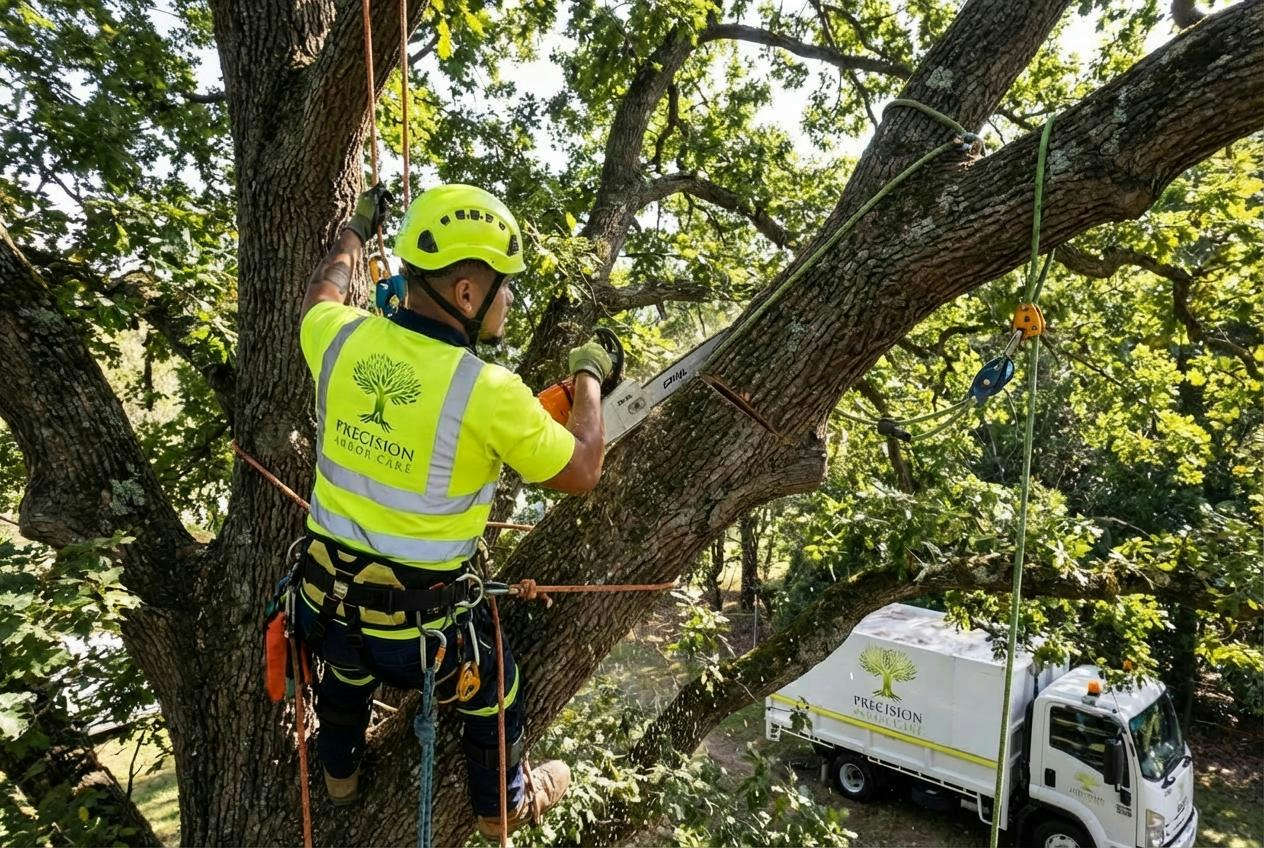
Heavy limbs, dead wood and clearance cuts, made at the branch collar with spikeless climbing, then chipped on site and cleaned up.
Keep reading
More on cuts, timing and safety
Getting the Three Cuts Done on Your Tree
Knowing the 1/2/3 rule of pruning is one thing. Doing it on a heavy limb, with the branch over your head, is another. Precision Arbor Care is a family-run tree service with over 25 years of family industry experience, and taking a limb off a tree is part of the job.
There is no pushy selling. You get a free on-site quote from Rob, and the price is fixed before any work starts.
On the day, we climb without spikes, which protects the bark, and make the cuts at the branch collar. Heavy sections are lowered by rope and pulley, the wood is chipped on site, and you can keep the mulch or have it taken away. Clean-up is included.
What you end up with is a tree that is safe to have over the house and healthy for the seasons ahead.
Frequently Asked Questions About the 1/2/3 Rule of Pruning
What is the 1/2/3 rule of pruning?
Where do you make the first cut in the 1/2/3 rule of pruning?
What is the branch collar in the 1/2/3 rule of pruning?
Do you need the 1/2/3 rule of pruning for a small branch?
Should you seal the cut after the 1/2/3 rule of pruning?
Does the 1/2/3 rule of pruning ever end in a flush cut?
When should I call an arborist instead of using the 1/2/3 rule of pruning myself?
How We Work With You
Our process is straightforward and designed around your needs.
Speak with us today
Get a free quote for the 1/2/3 rule of pruning done properly on your tree
Ask for Rob and he will call you back himself, usually the same day. Most jobs wrap up in a single day, and payment is due on completion.

Written by
Rob Tufuga
Founder & Lead Arborist, Precision Arbor Care
Rob has been climbing, cutting and shaping trees across Melbourne for more than 15 years. He started Precision Arbor Care to do tree work the way he always wished he could when he worked for bigger crews: one job at a time, no upselling, and an honest number on the quote.
Sources
- International Society of Arboriculture: Pruning Mature Trees (2021)
- USDA Forest Service: How to Prune Trees (NA-FR-01-95, revised 2012)
- University of Florida IFAS Extension Lake County: The 3-Cut Tree Pruning Practice
- Whitehorse City Council: Tree lopping and pruning
- Standards Australia: AS 4373-2007 Pruning of amenity trees (preview)
- Energy Safe Victoria: Trees and vegetation FAQ
Information in the arboriculture industry changes frequently, and linked content may change or become outdated. Every tree and property is different, and council rules vary. Please contact us for advice and a free quote suited to your exact job.