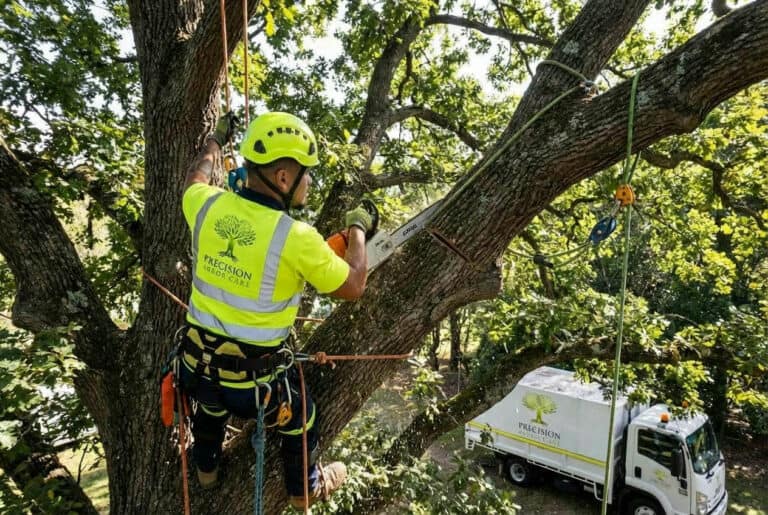
Pruning vs trimming is a common question before a tree job, and the honest answer is that the two words overlap. In everyday talk, a trim is a tidy-up and pruning is careful work on the structure of a tree. Arborists and the Australian Standard use the word pruning. What matters more than the word is which branches come off, where the cuts go, and why.
This guide explains pruning vs trimming in plain terms: what each word usually means, how the two differ for trees and for hedges, why the label matters when you book, and what happens on each kind of visit. Every number here traces back to a source, listed at the end.
Related reading
- Our tree pruning service: for trees that need choosing, not just tidying.
- Our hedge trimming service: for hedges and formal shapes.
- Tree lopping vs pruning: where a trim can go wrong.
- How often to trim a hedge: keeping a hedge in shape.
Pruning vs Trimming: The Short Answer
In the pruning vs trimming question, most of the difference is purpose. Pruning means cutting chosen branches for a reason: safety, the health of the tree, or its shape[1]. Trimming is the everyday word for a lighter tidy-up, such as shortening growth, neatening an outline or keeping a hedge in shape.
The two words are not sealed boxes. The US Forest Service, in a guide about pruning, describes trimming branches that block lines of sight as one part of safety pruning[1]. Gardening Australia’s pruning guide uses trim, chop and shape as everyday words for the same craft[7]. So for a tree, trimming is best treated as a light kind of pruning. For a hedge, it is a job of its own.
That is why pruning vs trimming is really a question about the job. Ask what will be cut and why, and you will get a better answer than any label can give you.
What Does Pruning Mean?
In pruning vs trimming, pruning is the word with a clear meaning in the trade. It is the selective removal of branches. The ISA’s rule of thumb is that every cut needs a reason, because each cut can change how the tree grows[2]. The US Forest Service describes the aim as strong, healthy, attractive plants[1].
The ISA describes four pruning techniques[2]:
- Cleaning: removing dead, dying, diseased, weakly attached and low-vigor branches.
- Raising: taking off the lower branches to give clearance for buildings, vehicles and people.
- Reduction: making the tree smaller, often to clear utility lines.
- Thinning: reducing the density of foliage at the edge of the crown to let in more wind and light.
The Australian Standard, AS 4373-2007 Pruning of amenity trees, covers the same ground in its scope. Its scope lists seven kinds of pruning, from deadwood removal and crown lifting to crown thinning and reduction pruning[3]. Each one is a job with a purpose.

What Does Trimming Mean?
In the pruning vs trimming debate, trimming has no separate meaning in the Standard’s scope. It is an everyday word, and it usually points to one of two things.
A light tidy-up of a tree. This means shortening growth that has reached a roof, fence or path, or lifting a few low branches. That is pruning on a small scale, and the same rules apply. The cut still goes just outside the branch collar[2], and the reason should still be clear.
Shaping a hedge or a formal plant. Here trimming means clipping the outer growth back to a tidy line. The University of Maryland describes shearing as using hedge clippers or electric shears to cut shrubs quickly into geometric shapes[6]. AS 4373 leaves this work out. Its scope names topiary, espalier and hedging as forms of pruning it does not cover[3].
We treat the two as separate jobs in our own work. Tree pruning and hedge trimming are separate services, and each has its own methods. More on that below.
Pruning vs Trimming: Five Differences
Here is how pruning vs trimming compares when you set trees and hedges side by side.
| Pruning (trees) | Trimming (hedges and shapes) | |
|---|---|---|
| Main aim | Safety, tree health and structure[1] | A tidy outline and a set height |
| What is cut | Chosen branches, each for a reason[2] | Outer growth, cut to a shape[6] |
| Where the cuts go | Just outside the branch collar[2] | Across the surface of the plant |
| How it is done | Climbing and rigging, with cuts placed at the branch collar | Trimmed along the line, with lift access for taller hedges |
| Standard that applies | AS 4373 covers it[3] | AS 4373 leaves hedging out[3] |
The table shows the pattern. In pruning vs trimming, the big split is between a tree, where each cut is chosen, and a hedge, where the whole surface is cut to a line.
One yard, two jobs
Picture a yard with a hedge along the fence and a tall tree near the house. The hedge has grown past its line. The tree has a low branch scraping the roof and some dead wood high up. Both get called a trim.
Yet the hedge job is about a tidy edge, cut across the whole surface. The tree job is about choosing branches: lift the low one, take out the dead wood and leave the rest alone. That is pruning vs trimming in one yard. A quote for a trim should say which plant, which cuts and how much comes off.
Why Pruning vs Trimming Matters When You Book
If pruning vs trimming were only about words, it would not matter. It matters because one label can cover very different jobs. There are four places where the difference shows up.
One word, many jobs
In pruning vs trimming terms, a trim can mean taking a little off the ends. It can also mean cutting the top out of a tree. Those are not the same job, and the tree does not respond to them in the same way. The Standard lists lopping, topping and flush cutting as unacceptable practices[3]. Whitehorse City Council goes further and says lopping is bad for the health of trees[4].
How much comes off
The ISA says heavy pruning can be a significant health stress, because removing foliage reduces growth and stored energy reserves[2]. If someone offers a big trim in one visit, ask how much of the crown that is.
The cut itself
The US Forest Service lists tipping, which means cutting branches back square and leaving long stubs, among the practices that harm trees[1]. A trim done that way is not a light job. It hurts the tree.
“Rob was very careful not to harm the tree while making sure I was happy with how it looked.”
Scooby · ★★★★★ verified Google review
Council rules and pruning vs trimming
Councils write their tree rules around pruning done to the Standard. Bayside City Council says you do not need a tree permit if an arborist does the work in line with AS 4373-2007[5]. For native trees protected by a Vegetation Protection Overlay, it says works must follow AS 4373 to count as pruning[5]. In other words, the label on the work can decide which rules apply.
Local laws vary, so check with your council before any cut. Our tree permit guide shows how councils approach protected trees across Melbourne.
- Accepting a trim with no detail on the cuts
- Topping, lopping or cutting branches back square[1]
- Removing a big share of the crown in one go
- Pruning near powerlines yourself
- Assuming hedge methods suit a tree
Pruning vs Trimming: What Happens on Each Visit
Here is what the two jobs look like on the day.
Read more about our tree pruning service and our hedge trimming service.
Not sure which side of pruning vs trimming your tree or hedge falls on? Book a free on-site quote and put the question to Rob.
How to Choose Between Pruning vs Trimming
Start with what the plant is doing. The signpost below matches common pruning vs trimming problems to the kind of work they call for.

A tree that is too big for its space is a special case, because the fix may be staged reduction or removal rather than a trim[1]. For a small hedge or a low branch you can reach from the ground, a careful homeowner can do the job. Once the work is up in the tree, or near powerlines, the pruning vs trimming question is best answered by someone who climbs for a living.
“The job was completed quickly and professionally with the cleanup excellent.”
Trish · ★★★★★ verified Google review

Related service
Tree Pruning in Melbourne
Tree pruning from a light lift of low branches to heavier weight reduction, with cuts at the branch collar and a tidy site at the end.
Keep reading
More on trees and hedges
Getting the Right Job Done: Tree, Hedge or Both
The pruning vs trimming question does not need to be complicated. Tell us what you can see: a tree that has crept over the roof, a hedge that has got away from you, or both. Precision Arbor Care offers tree pruning and hedge trimming as two separate services, so each job gets the method it suits.
Nobody will push you into anything. The quote from Rob is free and given on site, and you can ask whatever you like.
Tree jobs are done with spikeless climbing, which protects the bark. Taller hedges are reached with lift access, and every clipping is removed.
Payment is due on completion, and most jobs are done in a day. If yours is bigger than that, talk to Rob about payment timing.
Frequently Asked Questions About Pruning vs Trimming
What is the difference between pruning vs trimming?
Is tree trimming the same as tree pruning?
Is pruning vs trimming different for hedges?
Does trimming hurt a tree?
Does a permit apply to pruning vs trimming in Melbourne?
What is the difference between pruning and lopping?
Which is better for my tree, pruning vs trimming?
How We Work With You
Our process is straightforward and designed around your needs.
Speak with us today
Get a free quote and a straight answer on pruning vs trimming for your property
Ask for a free on-site quote and put your question to Rob directly. The price is fixed before any work starts.

Written by
Rob Tufuga
Founder & Lead Arborist, Precision Arbor Care
Rob has been climbing, cutting and shaping trees across Melbourne for more than 15 years. He started Precision Arbor Care to do tree work the way he always wished he could when he worked for bigger crews: one job at a time, no upselling, and an honest number on the quote.
Sources
- USDA Forest Service: How to Prune Trees (NA-FR-01-95, revised 2012)
- International Society of Arboriculture: Pruning Mature Trees (2021)
- Standards Australia: AS 4373-2007 Pruning of amenity trees (preview)
- Whitehorse City Council: Tree lopping and pruning
- Bayside City Council: Tree pruning and maintenance on private property, permit guide
- University of Maryland Extension: Pruning Shrubs and Hedges in the Home Garden
- ABC Gardening Australia: Pruning 101
Information in the arboriculture industry changes frequently, and linked content may change or become outdated. Every tree and property is different, and council rules vary. Please contact us for advice and a free quote suited to your exact job.