Pruning gum trees is different from pruning most garden trees, and it pays to know why before anyone picks up a saw. Eucalypts grow fast, carry heavy timber, and respond to bad cuts with a burst of weak regrowth. Done well, pruning keeps a gum safe, healthy and in proportion with your house for decades. Done badly, it creates the very hazard you were trying to remove.
This guide answers the questions homeowners ask us most about pruning gum trees: whether they can be pruned at all, how much you can take off, why topping is a mistake, when to prune, and when a council permit or the powerlines change the rules. Every figure is backed by a source, listed at the bottom of the page.
Related reading
- Our tree pruning service: how we prune trees across Melbourne.
- Eucalypt tree removal: when a gum is past saving.
- Tree pruning mistakes to avoid: the cuts that do more harm than good.
- The best time to prune trees in Melbourne: species by species.
Can Gum Trees Be Pruned?
Yes. Gum trees can be pruned, and most suburban gums benefit from it at some stage, because they share space with roofs, fences and driveways. The difference is in the approach. Eucalypts carry dormant buds under the bark that burst into life when the tree is cut hard, so the way you prune decides what grows back.
When we’re pruning gum trees, the job usually means one or more of these:
- Deadwooding: removing dead and dying limbs, which gums shed naturally and can drop without warning.
- Crown lifting: taking off lower branches to clear a roof, path or driveway.
- End-weight reduction: shortening long, heavy limbs back to a strong side branch, so less weight hangs out over a target.
- Clearance pruning: cutting branches back from the house, gutters, solar panels or the neighbour’s roof.
Pruning gum trees properly never includes cutting the top out of the tree or stripping it back to bare stubs. Both come up again below, because they are the two most common mistakes we’re called in to fix.
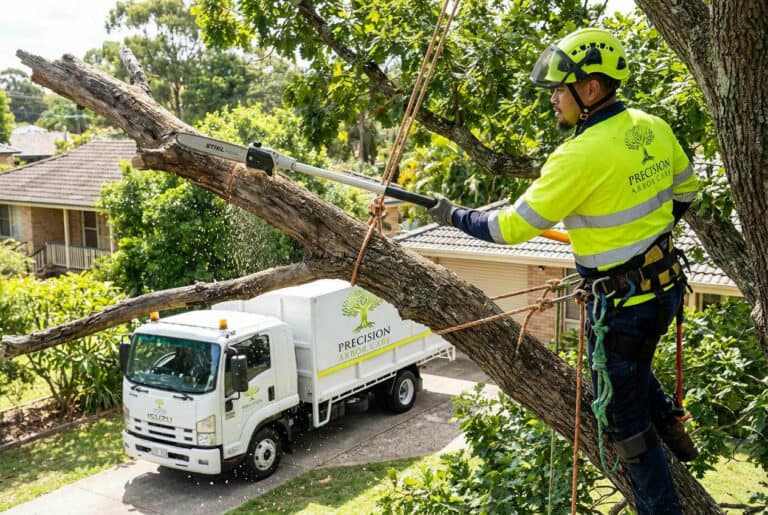
Where a whole limb has to come off, the way it is cut matters as much as which limb it is. Heavy gum limbs are taken down in stages so the weight never tears the bark, and the last cut sits just outside the branch collar, the slightly swollen ring where the limb joins the trunk[1].

How Much Can You Cut Off a Eucalyptus Tree?
The International Society of Arboriculture’s guidance is that no more than 25% of a tree’s crown should be removed at once, and less for mature trees[1]. That rule matters even more when pruning gum trees. Take too much and the tree reacts by pushing out a thicket of new shoots to replace the lost leaves, which puts you back where you started, only with weaker wood.
In practice, a big reduction is often better done in stages. One option is to take the heaviest, riskiest limbs this year and come back in a season or two to refine the shape, rather than trying to fix twenty years of growth in one day. Old, stressed or drought-affected gums get an even lighter touch.
Where a branch is shortened rather than removed, the cut should go back to a side branch big enough to take over as the new tip. The ISA puts that at no less than one-third the diameter of the stem being cut[1]. Cut to anything smaller and the limb tends to die back or sprout from the wound.
“Rob and his team arrived on time and did a great job, explaining exactly what the job entailed to prune branches off a huge gum tree. The area around the tree was surrounded by garden and garden pots. The team were very careful to ensure no damage occurred to plants and pots.”
Trish · ★★★★★ verified Google review
Can I Cut the Top Off My Eucalyptus Tree?
You can, but you shouldn’t. Topping a tree, which means cutting the main stems back to stubs to make it shorter, can remove 50-100% of its leaf-bearing crown[2]. The tree is starved of the leaves it uses to make food, and it answers by forcing out several fast shoots below every cut.
Those new shoots are the real problem. They grow from buds near the surface of the old branches, so they are anchored only in the outer layers of wood and are weakly attached[2]. In some species they can grow as much as 6 metres in a single year[2]. Within a few seasons a topped gum can be as tall as it was, with a crown full of heavy shoots that are far more likely to break than the original branches.
That is why the Australian Standard for this work, AS 4373-2007 Pruning of amenity trees[3], treats lopping and topping as unacceptable practice. When pruning gum trees to control height, the honest options are a staged crown reduction to proper side branches, or removal and replanting with something that suits the space. Our eucalypt removal page covers the second option.
- Cut just outside the branch collar
- Shorten limbs back to a side branch at least a third of the stem’s size
- Take no more than a quarter of the crown at once
- Remove dead wood as soon as you spot it
- Check your council’s rules before you start
- Topping the tree or cutting to stubs
- Flush cuts into the trunk
- Climbing with spikes on a tree you’re keeping
- Using a chainsaw from a ladder
- Pruning anywhere near powerlines
When Is the Best Time for Pruning Gum Trees in Melbourne?
Gums are evergreen, so they lack the clear winter rest that makes deciduous trees easy to time. That gives you more flexibility, with a few sensible rules:
- Dead, broken and hanging limbs: deal with them any time. Don’t wait for a season if a limb is threatening the house or a path.
- Bigger structural work: the cooler months are kinder, because the tree isn’t also coping with heat and water stress.
- Heatwaves and droughts: avoid heavy cuts, since the tree has the least in reserve to recover.
- Before summer: a check of long, heavy limbs over the house and outdoor areas is worth doing ahead of the hot months.
For other species, our guide to the best time to prune trees in Melbourne goes tree by tree.
Got a gum that has outgrown its spot? Rob will look at it with you and tell you honestly what it needs.
Why Gum Trees Drop Branches Without Warning
Every summer, big gum limbs come down on still, hot days, and the effect has been studied for decades. Arborists call it summer branch drop. Research published by the International Society of Arboriculture describes branches failing on hot, calm summer afternoons in Australia, South Africa and the United States, across species from at least 19 genera[6]. The same paper points to heavy limb weight as one of the likely factors[6].
Nobody can predict exactly which limb will go, but the risk is not random either. The limbs most likely to cause damage are long, heavy and close to horizontal, reaching out over something you care about: the roof, the car, the deck or the kids’ play area. Reducing the end weight on those limbs, back to a strong side branch, is one of the best reasons for pruning gum trees at all.
“We had to recently remove a very large limb that was water damaged from our gum tree and presenting risk to our property. The team were quick to respond and remove the limb in a professional and quick way at a fair price.”
Paul · ★★★★★ verified Google review

Do You Need a Permit to Prune a Gum Tree in Melbourne?
Whether pruning gum trees needs a permit depends on your council, the size of the tree and any planning controls on your block, so check before any work starts. Boroondara is a good example of how the rules can work. There, a canopy tree is one with a trunk circumference of 110 cm or more, measured 1.4 m above the ground[5]. Canopy trees can be pruned without a permit, but the pruning must follow AS 4373-2007[4]. Significant trees are stricter: you need a permit to prune them at all[4].
Other councils set different thresholds, and some protect native vegetation or particular trees through planning overlays. Rob can talk through what to check for your address before any cut is made. Our tree removal permit guide explains how permits work across Melbourne.
What you should know before pruning a gum
- Check whether your council protects the tree by size, species or a significant tree listing.
- Check for planning overlays on your block that cover vegetation.
- Look up before you cut: note any powerlines or the service line to the house.
- Keep the prune to what the tree can recover from, and stage bigger reductions.
Gum Trees and Powerlines: Who Is Responsible?
Gums grow quickly towards overhead lines, so this comes up often. Energy Safe Victoria’s guidance is that if a tree grows on your property, you are responsible for keeping it clear of the service line that connects to your house. You should clear it before it grows within one metre of that line in any direction[7]. For pruning near powerlines, ESV advises contacting the electricity distribution business for your area[7].
The rules on who can work near lines, and how close, are strict for good reason. If a branch is close to the lines, Rob can tell you on site whether it’s a job for us or one for your distributor.
Pruning Gum Trees Yourself vs Calling an Arborist
Small gums and low branches you can reach from the ground are fair game for a careful homeowner with a sharp pruning saw. The rules above still apply: cut just outside the branch collar, never leave stubs, and never take too much at once[1].
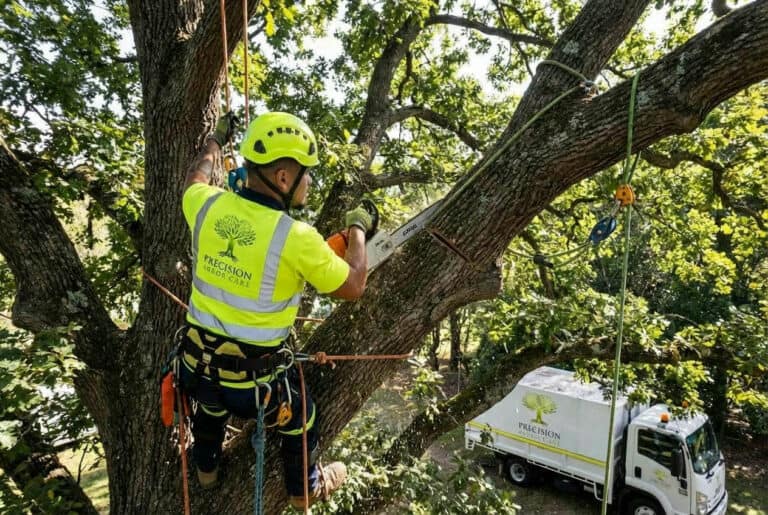
Anything above head height, anything heavy, and anything over a roof, fence or powerline is a different matter. Gum timber is dense and heavy, and limbs can split and swing unpredictably as they’re cut. Ladders and chainsaws are a bad combination at the best of times. That’s the point to call an arborist who climbs with the right gear and lowers heavy sections on ropes.
Related service
Tree Pruning in Melbourne
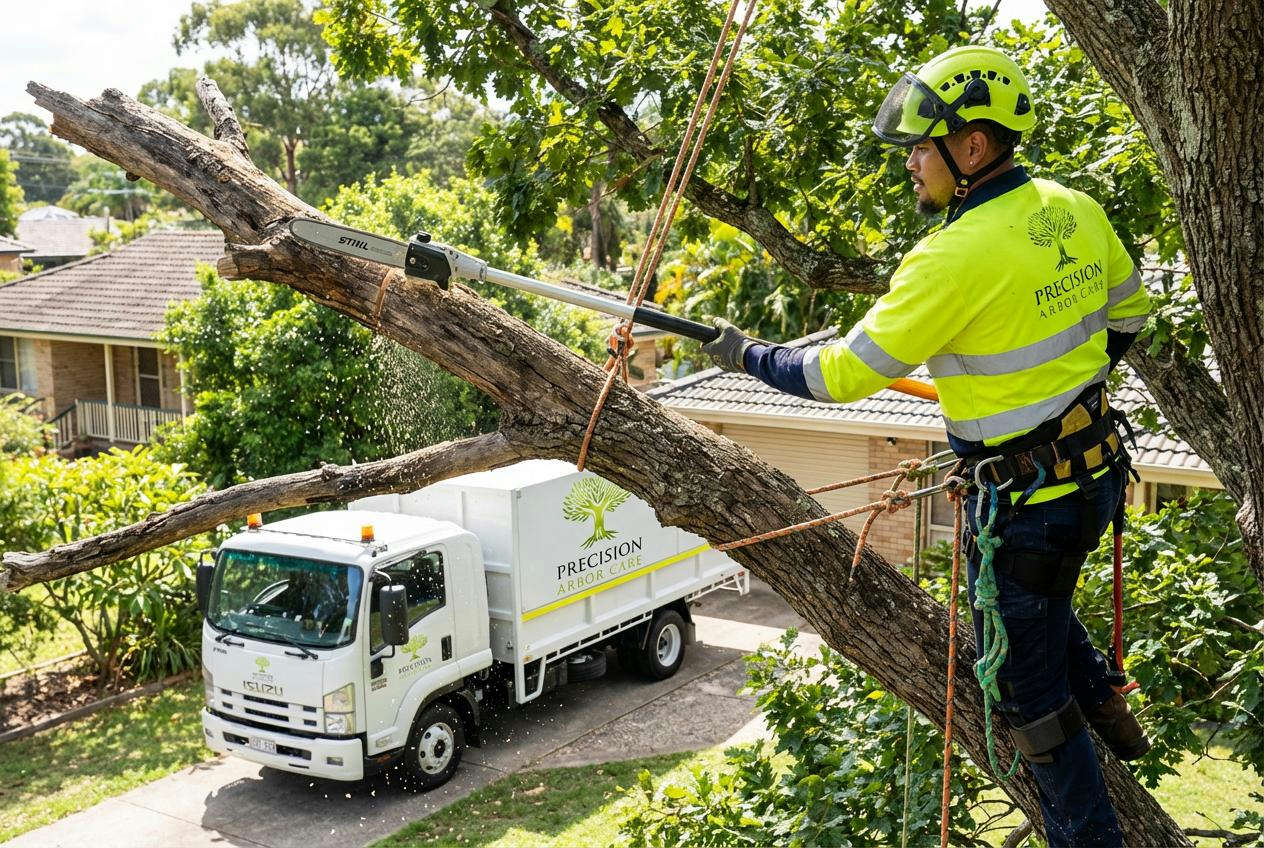
Deadwooding, crown lifting and weight reduction for gums and every other tree, done with spikeless climbing and proper cuts, then chipped and cleaned up.
Keep reading
More tree pruning guides
How You Get a Healthy, Safe Gum Tree
Pruning gum trees doesn’t have to be complicated. At Precision Arbor Care, we help you understand what your tree actually needs and make sure the work protects your home, your garden and the tree itself.
No pushy sales tactics. We have a friendly conversation, look at the tree with you and explain the options. You move forward at your own pace. People choose to work with us because we explain what we see and help them feel confident about the right call for their tree.
Rob walks you through which limbs need attention and why, so nothing catches you off guard. He explains how the job will run and what the fixed price covers, including the clean-up. And he can point you to the council rules to check for your address before any cut is made.
Our goal is straightforward. We want you to have a gum tree that is safe to live with and still healthy for years to come.
Frequently Asked Questions About Pruning Gum Trees
Can gum trees be pruned?
How much can you cut off a eucalyptus tree?
Can I cut the top off my eucalyptus tree?
When should you not prune a gum tree?
Will pruning stop my gum tree dropping branches?
How much does it cost to cut down a big gum tree?
What are the common mistakes when pruning?
How We Work With You
Our process is straightforward and designed around your needs.
Speak with us today
Get a free quote for pruning gum trees on your property
Rob calls back personally, usually the same day. He’ll come out, look at the tree with you and give you a fixed price, with the chipping and clean-up included. Most jobs are done in a single day with payment on completion.

Written by
Rob Tufuga
Founder & Lead Arborist, Precision Arbor Care
Rob has been climbing, cutting and shaping trees across Melbourne for more than 15 years. He started Precision Arbor Care to do tree work the way he always wished he could when he worked for bigger crews: one job at a time, no upselling, and an honest number on the quote.
Sources
- International Society of Arboriculture: Pruning Mature Trees (2021)
- International Society of Arboriculture: Why Topping Hurts Trees
- Standards Australia: AS 4373-2007 Pruning of amenity trees
- City of Boroondara: Tree works permits
- City of Boroondara: Protected and significant trees
- Harris, R.W. (1983) Summer Branch Drop. Arboriculture & Urban Forestry 9(4): 111
- Energy Safe Victoria: Trees and vegetation FAQ
Information in the arboriculture industry changes frequently, and linked content may change or become outdated. Every tree and property is different, and council rules vary. Please contact us for advice and a free quote suited to your exact job.