The 10/50 rule is a Victorian planning exemption that lets some homeowners clear trees within 10 metres of their house, and other vegetation up to 50 metres, without a planning permit. It only applies in certain places, to certain homes, and only for bushfire protection[1][2]. It is not a licence to clear whatever you like.
This guide explains who the 10/50 rule covers, what you can clear under it and what it does not allow. It is general information, not legal advice. Whether the rule applies to you depends on your property, so use the state’s planning tool and your council to check before anyone cuts anything. Every rule below comes from an official source, listed at the bottom of the page.
Related reading
- Our land clearing service: trees, stumps and green waste handled in one job.
- Tree removal permits in Melbourne: when a council rule comes into play.
- Land clearing permits in Victoria: the wider permit picture.
- Can I remove a tree myself in Victoria?: the honest answer.
What Is the 10/50 Rule?
The 10/50 rule is a permit exemption. Normally, a council or a planning overlay can require a planning permit before you remove, destroy or lop vegetation. The exemption says that, for bushfire protection, some owners do not need a permit to clear around an existing home. It was brought in after the 2009 Victorian Bushfires Royal Commission, to make it easier for owners in bushfire risk areas to remove vegetation on their property[1]. It sits in clause 52.12 of the Victoria Planning Provisions[2].
The name is shorthand for two limits. In a Bushfire Management Overlay, you do not need a permit to clear any vegetation, including trees, within 10 metres of your house[1]. You also do not need one to clear any vegetation other than trees within 50 metres of it[1]. In other designated bushfire prone areas, the same idea is called the 10/30 rule, and the outer limit is 30 metres[1].
The word clearing has a wide meaning here. The state fact sheet says clearing includes the removal, destruction and lopping of vegetation[2], so cutting a tree back counts as well as cutting it down.

Who Does the 10/50 Rule Apply To?
Fewer people than you might expect. The rule covers a limited group of homes, and the conditions stack up:
- An existing building. The exemptions apply to existing buildings and fences only, not to proposed ones[2].
- A building used for accommodation. That includes a house, and other accommodation such as a dependent person’s unit or a bed and breakfast[2].
- A building of the right age. It must have been built or approved before 10 September 2009, or built to replace a home damaged or destroyed by bushfire between 1 January and 31 March 2009[2]. The 50 metre part has a few extra date options, so read the fact sheet for your case[2].
- The right place on the map. The 10 metre and 30 metre parts apply in designated bushfire prone areas. The 50 metre part applies in the Bushfire Management Overlay[2].
In short, the 10/50 rule is for existing, older homes that sit inside the Bushfire Management Overlay[2]. Everyone else needs to check which rule, if any, applies to them[1]. If your home was built after 10 September 2009, the CFA says you will likely need a permit to clear, and should contact your council[1].
How to tell if you are in the Bushfire Management Overlay
The overlay applies to land in Victoria that may be at risk from bushfire[5]. To find out if it covers yours, put your address into the state government’s planning tool, VicPlan. It generates a planning property report, with a list of the zones and overlays that apply to your land[5].
There is one catch. The maps follow bushfire hazard, not property boundaries, so it is common for a property to be only partly mapped. The exemptions apply only if the building sits on the mapped part. If part of the building is inside the mapped area, you can manage vegetation around the whole building, up to the allowed limit[2].
Your land, not the neighbour’s
The rule is for vegetation on your own property. Before anything is removed from neighbouring land, you need written permission from the landowner[1][2].
“Rob came straight away and spoke about what they would do and gave a very reasonable price as well as a prompt date they could do the work.”
Bruce · ★★★★★ verified Google review
What You Can Clear Under the 10/50 Rule
| Where | What you can clear without a planning permit | Rule |
|---|---|---|
| Within 10 metres of an existing home | Any vegetation, including trees[1][2] | 10 metre rule, in a bushfire prone area or the overlay |
| 10 to 30 metres from the home, in a bushfire prone area | Vegetation other than trees[1][2] | 10/30 rule |
| 10 to 50 metres from the home, in the Bushfire Management Overlay | Vegetation other than trees[1][2] | 10/50 rule |
| Along a boundary fence built before 10 September 2009 | Vegetation, up to 4 metres wide across both sides combined[2] | Fence line rule |
Read the middle two rows again. Beyond 10 metres, the rule covers vegetation other than trees. Trees further out are not covered by it[1]. That is easy to overlook.
The exemption applies to native and non-native vegetation alike[2]. Where it applies, it also overrides planning permit conditions that would stop you removing vegetation, such as a landscaping condition on an old permit. Vegetation beyond the limits stays bound by the permit[2].
Not sure which trees near your home can come off? Rob will look at them with you and give you a fixed quote.
What the 10/50 Rule Does Not Allow
The exemption is narrow on purpose. The 10/50 rule does not give you permission to clear a whole block, a whole hillside or a neighbour’s trees.
- Check your property report for a bushfire prone area or overlay[5]
- Confirm your home was built or approved before 10 September 2009[2]
- Keep to 10 metres for trees, and to 30 or 50 metres for other vegetation[1]
- Get written permission before clearing on a neighbour’s land[2]
- Ask your council about native vegetation and local rules[1]
- Clearing trees beyond 10 metres of the home under this rule[1]
- Assuming a home built after September 2009 is covered[1]
- Clearing where a covenant or legal agreement bans removal[2]
- Pruning near powerlines without calling your distributor[8]
- Burning off in the Fire Danger Period without a written permit[7]
Two other limits are worth knowing about:
- Legal agreements and covenants. The fact sheet says the exemptions do not override legal agreements or covenants that stop native vegetation being removed, destroyed or lopped[2]. Your council or a planning lawyer can advise if you think one applies.
- Local rules. A 2020 state fact sheet noted that not all of the exemptions apply in the Shire of Yarra Ranges, because a local clause applies there[2]. That was the position when the sheet was written, so ask the council for the current rules.
There is a landslide caution too. Some councils apply an Erosion Management Overlay to land prone to landslide. The fact sheet says vegetation can be removed there without a permit under the exemptions, but owners are advised to keep vegetation that helps hold the slope, or to get expert advice first[2]. That is sensible for any steep block.
“Genuinely nice people who gave us a more than fair quote to remove a dead gum tree, and remove some low hanging branches from another.”
Nicole · ★★★★★ verified Google review
Does the New Canopy Tree Rule Change Anything?
From 15 September 2025, Victorian planning schemes include a canopy tree clause. Manningham City Council explains that you may now need a planning permit to remove a tree in a residential zone, even when there is no overlay on the property[4]. The same council says the clause does not override or limit other planning provisions, such as overlays and the bushfire requirements[4].
In plain terms, the two sets of rules sit side by side. Ask your council how they apply to your home before you decide which trees to take out.
A dangerous tree is a separate case
Manningham says an exemption applies if a tree is dangerous and poses an immediate risk of injury or damage, but only to the part of the tree that poses the risk. It advises getting an arborist to inspect the tree and put their advice in writing[3].
How to Check Whether the 10/50 Rule Applies to You
Work through these four checks in order, before any tree comes down. Save a copy of your property report, so you can show it to your council and to anyone quoting the work.

Clearing Safely: Trees, Powerlines and Green Waste
Getting the order right matters. Sort the rules first, then book the tree work, then plan what happens to the waste.
The CFA does not recommend removing trees yourself. It says to hire a qualified professional, because it is a dangerous and difficult job[1].
Powerlines add another layer. Energy Safe Victoria says that for a tree growing on your property, you are responsible for clearing it from the service line that connects to your house, and you should clear trees and shrubs before they grow within one metre of that line in any direction[8]. It also says to keep well clear of powerlines and to contact the electricity distribution business for your area about pruning near them[8].
Cutting is only half of the job. The CFA lists these ways of dealing with the material:
- Put small amounts in your green waste bin, if your area has a green waste collection[1].
- Take it to a local tip that accepts green waste[1].
- Mulch it, and use the mulch carefully on garden beds well away from the house and in broken patches, so you do not create a fuel corridor[1].
- Burn it off, where the rules allow[1].
Burning has its own rules. During the Fire Danger Period you can only burn off with a written permit, and burning off on a Total Fire Ban day is illegal even if you hold a permit[7]. Councils can also have local laws on lighting fires[7]. The CFA suggests considering safer alternatives first, such as mulching the material, using a green waste collection or taking it to a waste transfer station[7].
Clearing is one part of a bigger job. The CFA says to keep vegetation and flammable materials to a minimum within 10 metres of your home, and reminds owners that there are no fireproof trees or plants[6]. It also suggests replacing flammable mulches such as tanbark with river pebbles or gravel next to the house[6].

Related service
Land Clearing in Melbourne
Trees taken down in sections, stumps ground below ground level and the green waste chipped or taken away, all in the one job.
Keep reading
More land clearing guides
How You Get Trees Cleared Once the Rules Are Clear
Whether the 10/50 rule covers your home is a question for your property report and your council. Once you know what the rules allow, the tree work is the simpler part.
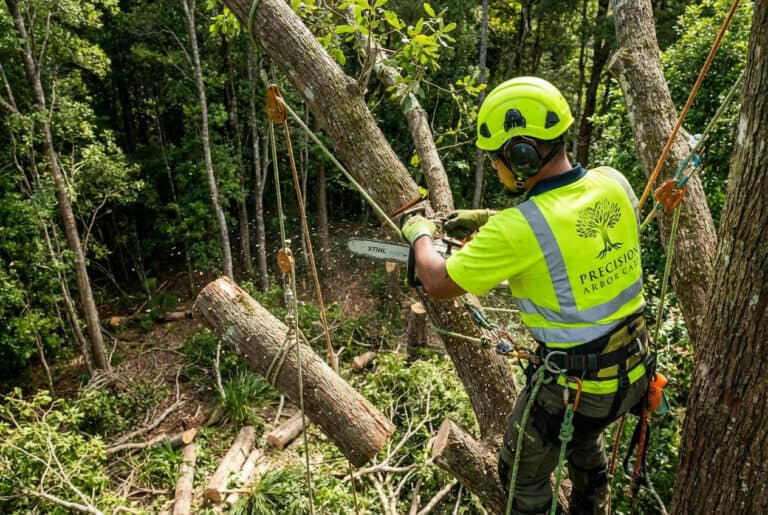
Precision Arbor Care uses professional climbing and rigging, takes trees down section by section and lowers the pieces on ropes and pulleys. Stumps can be ground out and the green waste dealt with in the same job, so the cleared area is not left half finished.
Ask Rob for a free on-site quote and the price is fixed before anything is cut. Show him which trees you plan to remove and what your council has confirmed, and the quote can follow that list.
The aim is a property that has been cleared safely, inside the limits your council has confirmed.
Frequently Asked Questions About the 10/50 Rule
What is the 10/50 rule in Victoria?
Does the 10/50 rule apply to my property?
Can I clear trees within 10 metres of my house without a permit?
What is the difference between the 10/30 rule and the 10/50 rule?
Does the 10/50 rule let me clear trees on my neighbour’s land?
Does the 10/50 rule apply to native trees?
Do I need an arborist to clear trees under the 10/50 rule?
How much does it cost to clear trees around a house?
How We Work With You
Our process is straightforward and designed around your needs.
Speak with us today
Get a free quote to clear trees around your home
Send Rob a quote request or ring him with the details of your property. He visits, looks over the trees you plan to remove and gives you a fixed price that covers the clean-up. Bring your council’s advice with you, so the job matches the rules.

Written by
Rob Tufuga
Founder & Lead Arborist, Precision Arbor Care
Rob has been climbing, cutting and shaping trees across Melbourne for more than 15 years. He started Precision Arbor Care to do tree work the way he always wished he could when he worked for bigger crews: one job at a time, no upselling, and an honest number on the quote.
Sources
- CFA: Removing vegetation, trees and other plants
- Victorian Government: Vegetation Clearing Exemptions, Bushfire Protection fact sheet (August 2020)
- Manningham City Council: Remove a tree on your property
- Manningham City Council: Canopy trees in residential areas
- CFA: Bushfire Management Overlay
- CFA: Designing a garden
- CFA: Burning off
- Energy Safe Victoria: Trees and vegetation FAQ
Information in the arboriculture industry changes frequently, and linked content may change or become outdated. Every tree and property is different, and council rules vary. Please contact us for advice and a free quote suited to your exact job.