A tree that looked harmless 10 years ago can quietly crack your sewer pipe, lift your driveway, or shift your home’s foundation. Tree root damage is one of the most expensive property problems in Melbourne — and by the time you notice it, the damage is usually well advanced.
This guide covers how root damage happens, which tree species cause the most problems, how to spot it early, and what you can do to prevent it.
How Tree Roots Damage Infrastructure
Tree roots don’t push through concrete or burst pipes with brute force. The process is slower and more subtle than that.
Pipes
Sewer and stormwater pipes are the most common target. Older clay and earthenware pipes have joints every 600mm-1,800mm, and over time, these joints develop small gaps. Tree roots are drawn to the moisture and nutrients escaping from those gaps.
A hair-thin root enters the joint, then grows inside the pipe. It branches out, trapping waste and creating blockages. Over months and years, the root mass expands until the pipe cracks or collapses entirely.
Modern PVC pipes are more resistant, but roots can still exploit poorly sealed joints or damage caused by ground movement.
Foundations
Tree roots draw large volumes of water from the soil. In Melbourne’s reactive clay soils — common across suburbs from the west through to the eastern ranges — this moisture extraction causes the soil to shrink. When the soil under a house footing shrinks unevenly, the footing moves. Cracks appear in walls, doors stick, and floors become uneven.
This is called “differential settlement,” and it’s a major structural issue. Repairing foundation damage can cost tens of thousands of dollars.
Paths, Driveways, and Retaining Walls
Surface roots from large trees lift concrete paths, crack driveways, and push retaining walls out of alignment. Unlike pipe or foundation damage, surface root damage is visible and tends to get worse with every growing season.
Tree Species That Cause the Most Problems in Melbourne
Not all trees are equal when it comes to root damage. These species are the worst offenders in Melbourne:
Eucalyptus (All Species)
Australia’s native gum trees are aggressive root spreaders. Their roots extend well beyond the canopy — often 2-3 times the height of the tree in every direction. Eucalyptus roots are notorious for invading sewer lines and drying out reactive clay soils.
Liquid Amber (Liquidambar styraciflua)
One of Melbourne’s most popular street and garden trees, but its roots are shallow and aggressive. They lift paths, invade garden beds, and block drains. Liquid ambers planted within 5 metres of a house regularly cause foundation issues.
Willow (Salix species)
Willows are water-seeking machines. Their roots travel enormous distances to find moisture, making them the number one cause of sewer pipe invasion in many Melbourne suburbs. A single willow can send roots 30-40 metres to reach a pipe.
Fig (Ficus species)
Figs — including the popular Moreton Bay Fig and Port Jackson Fig — have massive, spreading root systems. They’re spectacular trees, but completely unsuitable for residential blocks. Even smaller ornamental figs (Ficus hillii) can cause significant root damage.
Poplar (Populus species)
Fast-growing and thirsty, poplars dry out clay soils rapidly. They’re a common cause of foundation cracking in Melbourne’s northern and western suburbs.
Other Problem Species
- Camphor Laurel — aggressive roots, invasive species
- Coral Tree — shallow, spreading roots
- Plane Tree (Platanus) — large root system, commonly causes path lifting
- Privet — invasive roots, often planted too close to structures
Signs of Root Damage to Watch For
Root damage develops slowly. These are the early warning signs:
Pipe Damage
- Slow-draining sinks and toilets — often the first sign of root intrusion in sewer lines
- Gurgling sounds from drains
- Recurring blockages — if you’re calling a plumber more than once a year for the same drain, roots are likely the cause
- Sewage smell in the yard — indicates a cracked or collapsed pipe
- Wet patches in the lawn above buried pipe routes
Foundation Damage
- Cracks in interior walls — especially diagonal cracks near door and window frames
- Doors and windows that stick or won’t close properly
- Uneven floors — noticeable when you place a ball on the floor and it rolls
- Gaps between walls and ceiling or walls and floor
- Cracks in exterior brickwork — step cracking along mortar lines is a classic sign
Surface Damage
- Lifted or cracked concrete paths
- Driveway cracking or heaving
- Retaining walls leaning or bulging
- Garden edging pushed out of line
- Visible roots above ground level near structures
How to Prevent Root Damage
Prevention is always cheaper than repair. Here are the most effective methods:
Choose the Right Species
If you’re planting trees, choose species with non-invasive root systems. Good options for Melbourne include:
- Crepe Myrtle — compact roots, suitable near houses
- Ornamental Pear — moderate root system
- Japanese Maple — small, non-aggressive roots
- Magnolia (smaller varieties) — manageable root spread
- Banksia — native option with a contained root zone
As a general rule, don’t plant any tree closer to a structure than its expected mature height. For large species, double that distance.
Install Root Barriers
Root barriers are physical sheets (usually high-density polyethylene) buried vertically in the ground between a tree and a structure. They redirect roots downward and away from pipes, foundations, and paths.
Root barriers work best when installed at planting time, but they can be retrofitted around existing trees. Precision Arbor Care can advise on whether a root barrier is practical for your situation.
Maintain Your Pipes
- Get a CCTV drain inspection every 3-5 years if you have large trees near sewer or stormwater lines. This catches root intrusion early, before it becomes a major blockage or pipe collapse
- Replace old clay pipes with PVC when doing renovations. Modern joints are much more resistant to root entry
- Use chemical root treatments in drains as a preventive measure (copper sulphate is commonly used by plumbers)
Root Pruning
An arborist can selectively cut roots on one side of a tree to protect nearby structures. This must be done carefully — cutting too many roots can destabilise the tree or kill it. Root pruning should only be done by a qualified professional who understands the tree’s root architecture.
When Removal Is the Only Option
Sometimes the damage is too far advanced, or the tree is too close to the structure for any preventive measure to work. Removal becomes the practical choice when:
- Root damage is ongoing and will continue regardless of barriers or pruning
- The tree is within 3 metres of the house foundation on reactive clay soil
- Sewer pipes have been repaired multiple times and roots keep returning
- The tree has caused structural movement to the building
- An engineer or arborist recommends removal as part of a remediation plan
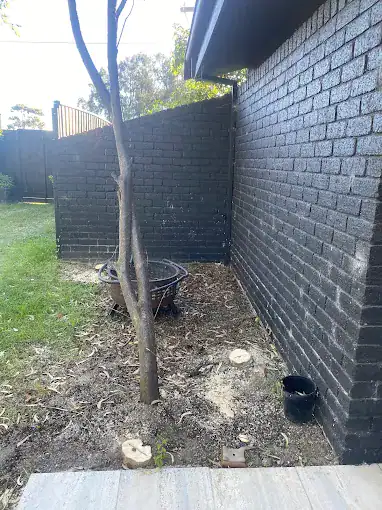
In these cases, removing the tree — including grinding the stump to prevent regrowth — is the most cost-effective long-term solution.
What to Do If Damage Has Already Occurred
If you’re already seeing signs of root damage, here’s the order of operations:
1. Get a plumber to CCTV inspect your drains and identify the source of any blockages 2. Get an arborist to assess the tree and confirm whether its roots are the cause 3. Get an engineer if you suspect foundation movement — they’ll assess the structural impact and recommend repairs 4. Decide on the tree — based on the arborist’s assessment, decide whether root pruning, a barrier, or removal is the right call 5. Fix the infrastructure — repair or replace pipes, restump if needed, fix cracked paths
Doing it in this order ensures you address the cause before spending money on repairs that the roots will just damage again.
Get a Professional Root Assessment
If you suspect tree roots are damaging your pipes, foundations, or paths, the first step is a proper assessment by a qualified arborist. Call Rob on 0413 606 544 to arrange an inspection. Precision Arbor Care services all Greater Melbourne suburbs and can advise on root barriers, selective root pruning, or removal — whatever makes the most sense for your property.