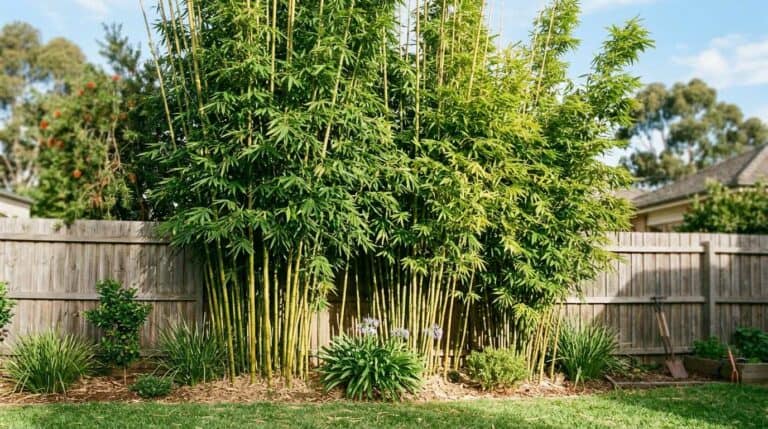
If you have bamboo in your Melbourne garden, the most important question is whether it is a running variety or a clumping one. The answer decides how much trouble you are in and what removal will cost. Running bamboos send rhizomes metres in every direction every year; clumping bamboos stay roughly where you planted them. This guide explains how to tell which type you have and what to do about each.
What Is Running Bamboo?
Running bamboo (technically leptomorph rhizomes) spreads horizontally underground. Each spring the parent clump sends rhizomes outward — sometimes 3 metres, sometimes 10. New culms shoot up wherever those rhizomes find soft soil. Without a physical barrier in the ground, running bamboo will eventually take over the whole yard.
Common running bamboos in Melbourne include:
- Phyllostachys aurea — Golden Bamboo, yellow-green canes, very common
- Phyllostachys nigra — Black Bamboo, dark canes, popular as a feature plant
- Phyllostachys edulis — Moso Bamboo, fat canes, less common in gardens
- Pseudosasa japonica — Arrow Bamboo, shorter, aggressive spreader
- Sasa spp. — Dwarf running bamboos, often sold as ground cover
What Is Clumping Bamboo?
Clumping bamboo (pachymorph rhizomes) sends out short, fat rhizomes that turn upward quickly to form new culms close to the parent. A clumping bamboo expands outward only 5-30cm a year. Over a decade you might end up with a clump 3-4 metres across, but it stays as a clump and does not invade the rest of the garden.
Common clumping bamboos:
- Bambusa textilis Gracilis — Slender Weaver’s Bamboo, the most popular hedge bamboo in Melbourne
- Bambusa multiplex — Hedge Bamboo
- Fargesia spp. — Cold-tolerant clumping bamboos from Asia
- Dendrocalamus spp. — Giant clumping bamboos (some grow huge)
How to Tell Which You Have
Method 1 — Look at the Growth Pattern
Step back and look at the whole clump. If it is a tight, fountain-shaped mass with all culms growing close together, it is probably clumping. If you can see scattered culms appearing 1-3 metres from the main clump, or culms in odd places like the middle of a lawn, it is running.
Method 2 — Dig a Trial Hole
Dig a hole 30cm deep about 60cm out from the edge of the visible clump. If you find pale-coloured rhizomes running horizontally, you have running bamboo. If you find only fine roots and no rhizomes that far out, you have clumping.
Method 3 — Identify the Culm Pattern
Running bamboos (Phyllostachys family) usually have a flat groove or sulcus running up one side of each cane between nodes. Clumping bamboos (Bambusa family) have rounded canes with no groove. If you can see the groove, it is running.
Method 4 — Ask Where It Came From
If the bamboo was planted by a previous owner 10+ years ago and has stayed in roughly one spot, it is almost certainly clumping. If it was planted from a cheap online supplier or a market and has spread quickly, suspect running.
Why It Matters for Removal
Clumping Bamboo
One excavation usually clears the entire plant. The root ball is dense but localised. We dig, lift the mass, fill the hole, and we are done in 3-6 hours for an average clump. Cost: $400-$1,200 depending on size and access.
Running Bamboo
This is where it gets expensive. The rhizomes can extend 5-10 metres from the visible clump, often under driveways, fences, and into neighbouring yards. Removal involves:
- Cutting all culms
- Excavating the main root mass
- Tracing and removing every rhizome we can find
- Treating regrowth on 1-2 follow-up visits
Costs range from $1,200 for a small invasion to $5,000+ for established runners that have crossed property lines.
What About “Non-Invasive Runners”?
Some nurseries sell running bamboos as “non-invasive” if they are slower growers. Do not believe it. All Phyllostachys species run. The only safe categories in a Melbourne garden are true clumpers — Bambusa, Fargesia, Chusquea, Borinda. If the label does not specifically say one of those genera, assume it spreads.
Can You Stop a Runner Without Removing It?
Yes, partly. Install a rhizome barrier — 60cm-deep HDPE root barrier dug around the clump in a complete circle. This contains the spread but does not eliminate it. Every spring you still need to cut any culms that emerge inside or outside the barrier line.
Barriers work better as prevention than cure — once rhizomes have already escaped, you have to remove them before installing a barrier or they will keep producing culms outside it.
What to Plant Instead
If you want the screening effect without the risk, the safe options for Melbourne are:
- Bambusa textilis Gracilis — true clumper, grows 4-6m tall, great hedge
- Lilly Pilly varieties (Backyard Bliss, Resilience)
- Photinia Red Robin
- Murraya paniculata
For Background on Bamboo Spread
If you want to understand why running bamboo gets out of control so fast, see why bamboo spreads so fast in Melbourne gardens.
Get a Free Bamboo Removal Quote
Send Rob a photo of your bamboo and the area around it. From the photo we can usually identify the species and tell you whether it is running or clumping. From there we give a quote on the spot. Call 0413 606 544 or see our bamboo removal services.